11:37am Friday, January 2nd, 2004 - View of Mexico City's main square , the Centro Zocalo, from the Cathedral Metropolitana bell towers.
With our boat anchored safely in Zihuatanejo, we and our friends from s/v Atalanta catch the eight-hour overnight deluxe coach to Mexico City arriving around 6 am. While the bus depot is bustling, it is still early and we set off walking in the pitch dark through the deserted garbage-strewn streets heading for the subway (El Metro). We catch the train to the Zocalo, officicially known here as the Plaza de la Constitucion, and emerge just at dawn onto the principal square in Mexico City. A huge Mexican flag gently flaps and the Cathedral Metropolitana looms behind. We are all feeling very excited to be here and slowly walk through the massive (but completely empty) square in awe as the sun creeps up. Bags in hand, we begin the search for our hotel. |
| Mexico City's central square, the Zocalo |
After locating our hotel, we head back to spend most of the day around the Zocalo, which was once the nucleus of Tenochtitlán, the Aztec island-capital and later the center of the entire Aztec empire. When Cortéz's Spaniards conquered the Aztecs in 1521, he immediately set about to establish a cathedral and a base for Christianity in "New Spain." Atop a steep spiralling staircase, we explore the bell towers. There are numerous bells of varying sizes and configurations rung skillfully by the bell ringers. As for the view from up here, the pollution is very bad today and visibility is poor, so we can barely see across the main square, as you can see in the previous photo!
 |
| Cathedral bell tower |
From the bell tower atop the catherdral in the background, we head off to the nearby Templo Mayor (major temple), which according to legend, is the first place the Aztecs called home after wandering for hundreds of years. Apparently, their war god Huitzilopochtli told them to keep moving until they saw an eagle perched on a cactus, eating a snake. When they arrived on this spot, they saw the predicted sign and the area became the center of Aztec religious, political and cultural living. Templo Mayor is now a huge excavated archaeological site that has revealed five layers of pyramids, each one built on top of the others as the Aztec empire grew. And at the peak of the structure is an altar, where endless human sacrifices were made to appease Huitzilopochtli. When Cortez conquered the Aztecs, he also destroyed Tenochtitlán and built Mexico City right on top of its ruins. In fact the Zocalo is built with Aztec-hewn stones.
 |
| Aztec's Major Temple with the Cathedral in the background. |
We have some fun as Michael pretends to try to make a call...but the phone is missing.
 |
| Hello...hello.... |
Saturday, January 3rd - 9:09 am - The day starts with fresh made OJ
After breakfast we are on our way to a famous park but we don't get too far...this orange juice is speaking to us and we oblige.
 |
| OJ doesn't get any fresher. |
Parque Ecologico de Xochimilco (Sho-She-MEEL-Co) (Ecological Park)
We make it to the park and have fun checking it out on bikes and a covered carrier of some sort. We are concerned at one point the wheels may fall off our carrier. Too funny.
3:40 pm - We hire a gondola and pilot for a tour of the canals. We are pleasantly surprised to be able to drink a few beers, have a full meal, all while listening to floating Mariachis. The gondola is propelled through the canals by a single long pole. It's a great time with lots of good laughs. Pablo, a local who offered to show us around, is on the right.
In some of the offset ruins at the Teotihuacan site, well preserved frescoes have been unearthed with a full range of colors. Interesting to note is that all the stone structures in the entire complex were once covered in 1"-2" plaster and painted in this fashion. The paintings tell the story of the deities and the lives of the people and are essential in understanding these ancient civilisations. The red paint is from squashed burrowing bugs from nopal leaves.
Late in the day at the south end of the site, we find these enourmous stone carvings at a smaller temple, up until very recently thought to have existed in honor of the god Quetzalcoatl, also know as the Feathered Serpent. Note the serpent heads interdisperesed with the square-headed carvings, which were mistakenly thought to have been Tlaloc, the rain god. The square-headed figures are now thought to represent the crocodilian diety (found in a number of ancient cultures in the area) that gave birth to time and the universe and who carries the world on its back. So unlike what our guide book says, the latest archaelogical interpretation now suggests the entire temple site has nothing to do with Quetzalcoatl, but rather served to pay homage to the measurement and accounting of time.
Inside the new basilica, the orginal cloak of Juan Diego is on display for all to see. Scientists from all walks (including most recently NASA) have failed to explain how a fiber garment with a 20-year maximum lifespan, pigments available in that era, and non-existant preservation and protection until recent years, has managed to survive in such dramatic condition after almost 500 years.
From in front of the original chapel on the hill where the Virgin appeared to Juan Diego, we sit and reverently ponder the significance of this place and event. Center-right one can see the roof of the new basilica; center-left the yellow roof of the old. And a statue of an Angel looks down on all and out southward to Mexico City in the distant haze and the dying light of the day.
Once we get back on the boat, Log 18 will have us moving south again, to tackle the infamous Gulf of Tehuantapec with potentially dangerous winds and seas en route out of Mexcio and into El Salvador, Central America.
 |
| Fun at the park. |
 |
| Will the carrier make it back to the start? |
Canals of Xochimilco (Sho-She-MEEL-Co
When the Aztecs established Tenochtitlán in the 12th century it was actually in the middle of a huge lake (Texcoco) in a big highland valley, the location where they saw the eagle perched on a cactus, eating a snake. So, over time, they built up the land by creating a grid of stakes driven into the shallow water and planting willows and fast growing crops on floating rafts attached to the grid. As the crops took root, they formed extremely fertile islands (chinampas) separated by an immense canal system for commerce and thus created the city of Tenochtitlán. Today, the remaining canals are popular with locals and tourists alike. |
| Canal travel |
3:40 pm - We hire a gondola and pilot for a tour of the canals. We are pleasantly surprised to be able to drink a few beers, have a full meal, all while listening to floating Mariachis. The gondola is propelled through the canals by a single long pole. It's a great time with lots of good laughs. Pablo, a local who offered to show us around, is on the right.
 |
| Pilot tour of the canals. |
 |
| All the kids enjoy the ride in the sun. |
11:44 am, Sunday, January 4th - Chapultepec Park
The biggest urban-situated park in all the Americas, this 1000-acre green expanse is loaded with world-class museums, hiking paths, a zoo, lakes, amusement parks, sports facilities and it also includes the Presidential residence seen in the background of this photo. Today, our plan is to visit Mexico's most famous museum, the Museum of Anthropology. |
| Presidential Palace |
11:59am - Crossing Abbey Road (a.k.a Reforma) on our way to the Museum of Anthropology
The museum we are heading for is considered by many to be the best of its kind in the world. It houses Mexico's most exquisite archaelological treasures within its 23 exhibition halls. These trace the histories of many central American groups from first migrations to the Spanish Conquest.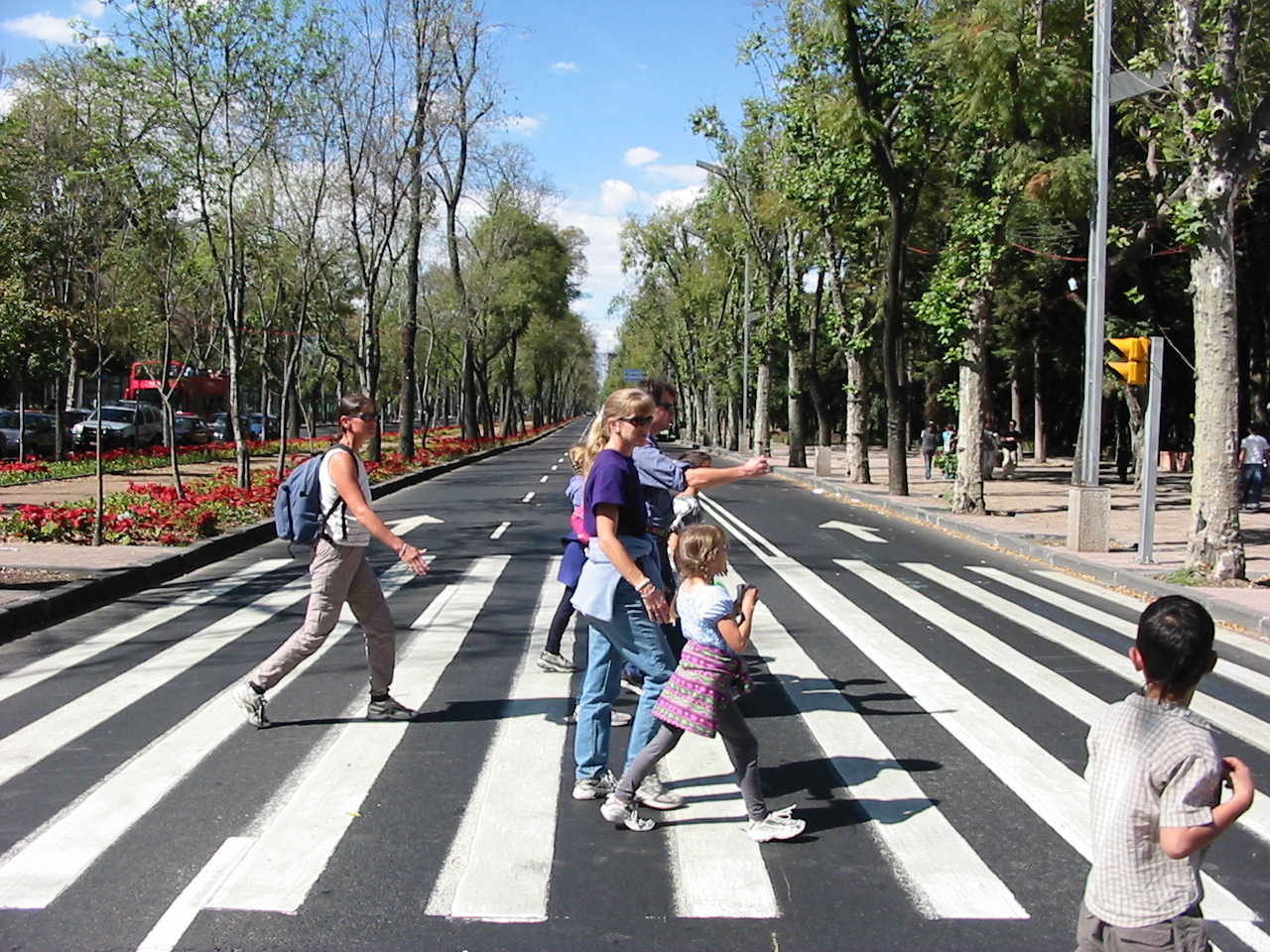 |
| Abbey Road |
2:16pm: Model of the amazing Aztec city of Tenochtitlán, now Mexico City
This picture gives a good impression of how present day Mexico City ended up in its current location, atop a huge lake in a big highland valley (see the wall mural in the photo). This was the scene - the Aztec city of Tenochtitlan - that the Spaniards found when they arrived in the 16th century. This centerpiece of the Aztec empire was so prominent that after Hernán Cortéz conquered the Aztecs, he founded present day Mexico City in its midst and upon its ruins. Unfortunately, the city has sunk over 10m since Cortez's day to the detriment of many buildings. The largest Aztec temple in the model, the Templo Mayor, represents the same location from which the 3rd picture in this log was taken, that of Cortéz's Cathedral Metropolitana. |
| Tenochtitlan, centre of the Aztec Empire. Now it's Mexico City. |
Monday, January 5th - View from atop the Pyramid of the Moon at Teotihuacán
Just north of Mexico City is the famous archeologicl site of Teotihuacán (teh-oh-tee- wah-KAN), discovered by the Aztecs (!) in 1325. The site had already been abandoned for over 500 years when they found it, overgrown and in ruins. Believing it to have been built by gods who sacrificied themselves here so that the sun would shine on the Aztec world, they adopted it as a ceremonial grounds. The pyramids of the Moon and of the Sun rival those in Egypt. Little is known of the society that once lived here for over 1000 years, disappearing as mysteriously as it had arisen. It is probably of Olmec origin and has Mayan influences. |
| Teotihuacan from atop the Pyramid of the Moon |
 |
| Pyramid of the Moon from the bottom |
In some of the offset ruins at the Teotihuacan site, well preserved frescoes have been unearthed with a full range of colors. Interesting to note is that all the stone structures in the entire complex were once covered in 1"-2" plaster and painted in this fashion. The paintings tell the story of the deities and the lives of the people and are essential in understanding these ancient civilisations. The red paint is from squashed burrowing bugs from nopal leaves.
 |
Unearthed frescoes Frescoes tell the story...
|
Late in the day at the south end of the site, we find these enourmous stone carvings at a smaller temple, up until very recently thought to have existed in honor of the god Quetzalcoatl, also know as the Feathered Serpent. Note the serpent heads interdisperesed with the square-headed carvings, which were mistakenly thought to have been Tlaloc, the rain god. The square-headed figures are now thought to represent the crocodilian diety (found in a number of ancient cultures in the area) that gave birth to time and the universe and who carries the world on its back. So unlike what our guide book says, the latest archaelogical interpretation now suggests the entire temple site has nothing to do with Quetzalcoatl, but rather served to pay homage to the measurement and accounting of time.
 |
| The pyramid found under the pyramid |
1:44pm Tuesday, January 6th - Mexico Through the Centuries, by Diego Rivera
Stretching the entire length of the Zocalo the government's Palacio Nacional is now the chief excutive center of the Republic of Mexico. It also houses monumental murals painted by Diego Rivera. This one, atop the grand staircase, is one of his most famous works, depicting the social history of Mexico. It's facsinating to study in the context of such history: from the fight for independence from Spain in 1810 to the start of the Mexican revolution in 1910 (land ownership reform). The murals tackle themes like the slave trade, class struggle, and the industrial revolution. |
| Diegos Frescos |
4:07pm Tuesday, January 6th - Basilica de Guadalupe
Later in the day, we catch El Metro out to the famous pilgrimage site of the Virgin of Guadalupe, the patron of Mexico and an icon of the nation's religious culture. In the background is the old basilica, built at the end of the 17th century. Note the tilt of the structure due to the ongoing settling (sinking) of Mexico City. Inside, all sorts of scafolding and bracing keep it from collapsing. A new modern-design basilica, built in the 1970s, sits off the picture to the left. |
| Basilica of the Virgin of Guadalupe. |
...Juan Diego's Holy Cloak
Behind the basilica, up the side of a small hill surrounded by lush gardens sits a small chapel built on the Virgin Mary's request. It goes like this...Mary first appeared as a vision on the hill to the indigenous peasant Juan Diego in December 1531. Juan Diego was to inform the bishop in Mexico City of his vision and Her desire to have a chapel built, but when he did he was doubted. So Juan returned 25 miles on foot to his home whereupon the Virgin appeared once again and instructed him to try the bishop again. The bishop, somewhat annoyed, asked that Juan Diego not return again without proof of the apiration he spoke of. And again the tired Juan returned to the hill. This time, Mary instructed Juan to an area where he was to gather a great variety of roses (in December) and to bring them to the bishop as proof. Juan gathered the roses in his cloak, and when he let them fall at the feet of the bishop, an image of the Virgin remained emblazoned on Diego's cloak. When the bishop saw this he fell to his knees believing, and a shrine was soon built. The monument in the picture depicts the bishop in front of Juan's cloak. |
| The Bishop before Juan Diego |
Inside the new basilica, the orginal cloak of Juan Diego is on display for all to see. Scientists from all walks (including most recently NASA) have failed to explain how a fiber garment with a 20-year maximum lifespan, pigments available in that era, and non-existant preservation and protection until recent years, has managed to survive in such dramatic condition after almost 500 years.
 |
| Cloak of Juan Diego |
From in front of the original chapel on the hill where the Virgin appeared to Juan Diego, we sit and reverently ponder the significance of this place and event. Center-right one can see the roof of the new basilica; center-left the yellow roof of the old. And a statue of an Angel looks down on all and out southward to Mexico City in the distant haze and the dying light of the day.
 |
| View from the hill where Juan Diego saw the Virgin |
9:01 pm Tuesday, January 6th - Feast of the Kings
After a very busy day, we return to our hotel from the Basilica carrying a Rosco de Reye, a traditional round sweet bread eaten in celebration of the Kings' visit to the Christ child in Bethlehem. Inside the bread are hidden little kings and any person who gets one has to cook and host a traditional Mexican meal including tomales on February 15th. |
| Feast of the Kings cake - Roscoe to Rey |
3:27pm Thursday, January 8th - Kids' Museum
Mexico City has a neat children's museum with lots of hands-on activities for the boys. Joel was ill yesterday, so we're making today as easy going as we can. Later today, we'll catch the overnight express back to the boat in Zihuatanejo. |
| Kids' Museum |
5:02pm - Taking the Metro Back to the Bus Station
Well, that's our tour of Mexico City. We have been really impressed with the sites and the hospitality. We haven't perceived any threats to our personal security and all-in-all leave with a high level of satisfaction. |
| Last decent into the underground to catch the metro |
Once we get back on the boat, Log 18 will have us moving south again, to tackle the infamous Gulf of Tehuantapec with potentially dangerous winds and seas en route out of Mexcio and into El Salvador, Central America.